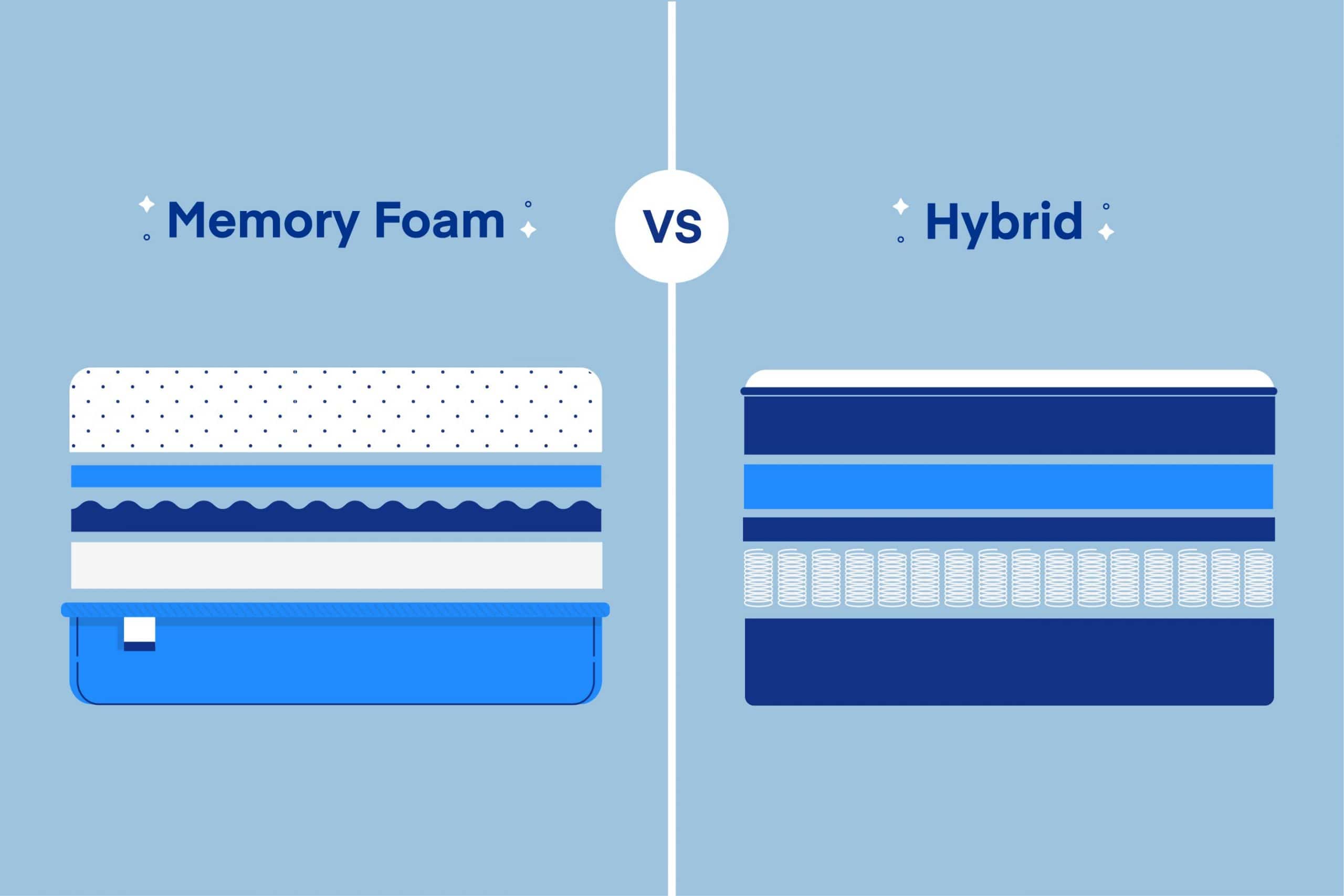
If you’re deciding between a memory foam and a hybrid mattress, this quick comparison table covers the most important differences at a glance.
| Feature | Memory Foam Mattress | Hybrid Mattress |
|---|---|---|
| Construction | Multiple layers of foam | Foam layers + individually pocketed coils |
| Feel | Soft, contouring, body-hugging | Balanced, responsive, supportive |
| Pressure Relief | Excellent | Very Good |
| Motion Isolation | Excellent | Good to Excellent |
| Cooling | Fair to Good (depends on foam) | Excellent |
| Edge Support | Fair | Excellent |
| Bounce | Low | Medium to High |
| Responsiveness | Slow | Fast |
| Best for Side Sleepers | Excellent | Very Good |
| Best for Back Sleepers | Very Good | Excellent |
| Best for Stomach Sleepers | Good (firmer models) | Excellent |
| Best for Couples | Excellent | Excellent |
| Durability | 7–10 years | 8–12 years |
| Price Range | Usually lower | Usually higher |
| Noise | Silent | Very Quiet |
| Adjustable Base Compatible | Yes | Most models |
Quick Answer
Choose a memory foam mattress if you want exceptional pressure relief, minimal motion transfer, and a plush, body-contouring feel. It’s especially suitable for side sleepers, couples, and people who experience shoulder or hip discomfort.
Choose a hybrid mattress if you prefer stronger support, cooler sleep, easier movement, and better edge stability. Hybrid mattresses are an excellent option for back sleepers, combination sleepers, heavier individuals, and anyone who tends to sleep warm.
What Is a Memory Foam Mattress?
A memory foam mattress is constructed primarily from foam layers, including memory foam, transition foam, and a high-density support core. Memory foam responds to your body heat and weight, allowing it to contour closely to your shape.
This contouring effect helps distribute body weight evenly, reducing pressure on common pain points such as the shoulders, hips, and lower back.
Unlike traditional spring mattresses, memory foam absorbs movement instead of transferring it across the bed. If your partner changes position frequently during the night, you’re much less likely to feel those movements.
Key Characteristics
- Deep body contouring
- Outstanding pressure relief
- Minimal motion transfer
- Quiet during movement
- Works well with adjustable bed frames
Many modern memory foam mattresses also include cooling technologies such as:
- Gel-infused foam
- Open-cell foam
- Copper-infused foam
- Graphite foam
- Ventilated comfort layers
These features help reduce one of the biggest complaints associated with older memory foam mattresses: heat retention.
What Is a Hybrid Mattress?
A hybrid mattress combines foam comfort layers with an individually pocketed coil support system.
Rather than relying entirely on foam, hybrid mattresses use hundreds or even thousands of independently wrapped steel coils underneath the comfort layers.
The result is a mattress that delivers both cushioning and responsive support.
Most hybrid mattresses include:
- Memory foam
- Latex foam
- Polyfoam comfort layers
- Pocketed coils
- Reinforced edge support
- High-density support foam
Because air flows freely through the coil layer, hybrids generally sleep cooler than all-foam mattresses.
Memory Foam vs Hybrid: What’s the Biggest Difference?
The main difference comes down to how the mattress supports your body.
Memory foam relies entirely on foam layers that mold closely to your shape, creating a cradling sensation. Many people describe it as sleeping “in” the mattress.
Hybrid mattresses, by contrast, combine foam with pocketed coils. The coils add bounce, airflow, and stronger support, giving you the feeling of sleeping “on” the mattress rather than sinking deeply into it.
Neither design is inherently better. The right choice depends on your sleeping position, body type, temperature preferences, and comfort expectations.
Comfort and Feel
Comfort is subjective, but understanding how each mattress feels can help narrow your options.
Memory Foam Feel
Memory foam responds gradually to pressure.
As you lie down, it contours around your body and evenly distributes your weight. This creates a “hugging” sensation that many side sleepers find incredibly comfortable.
People who enjoy a plush, cocoon-like sleeping experience often prefer memory foam.
However, some sleepers feel that traditional memory foam makes changing positions more difficult because of its slower response.
Best For
- Side sleepers
- Couples
- Pressure relief
- Hip pain
- Shoulder pain
- Motion isolation
Hybrid Feel
Hybrid mattresses feel noticeably more responsive.
The pocketed coils push back gently, preventing the deep sinking sensation common with softer memory foam beds.
Many sleepers appreciate the balanced combination of cushioning and support.
Changing positions is easier, making hybrids a popular choice for combination sleepers who rotate between their back, side, and stomach throughout the night.
Best For
- Combination sleepers
- Back sleepers
- Hot sleepers
- Heavier individuals
- People who prefer easier movement
Pressure Relief
Pressure relief plays a significant role in sleep quality, particularly if you experience joint discomfort or wake up with sore shoulders or hips.
Memory Foam Wins
Memory foam excels at distributing body weight evenly.
As it conforms closely to your body, it reduces concentrated pressure on prominent joints.
This is one reason physical therapists and sleep specialists often recommend supportive memory foam surfaces for people with recurring pressure-point discomfort.
Side sleepers usually notice the biggest improvement because their shoulders and hips sink naturally into the foam instead of bearing excessive pressure.
Hybrid Performance
Hybrid mattresses also relieve pressure effectively, especially premium models with thick comfort layers.
However, because the coil system provides upward support, hybrids generally don’t contour as deeply as memory foam.
Many people find this balance more comfortable because it combines cushioning with better spinal support.
Cooling and Temperature Regulation
Sleeping temperature can significantly influence sleep quality.
If you frequently wake up feeling hot or sweaty, cooling performance should be a priority.
Why Memory Foam Can Sleep Warm
Traditional memory foam retains body heat because of its dense structure.
When your body sinks into the foam, airflow becomes more limited.
Fortunately, many manufacturers have addressed this issue with advanced cooling materials such as:
- Gel-infused foam
- Open-cell foam
- Phase-change materials
- Copper-infused layers
- Ventilated designs
While these technologies improve airflow, memory foam generally remains warmer than hybrid mattresses.
Why Hybrid Mattresses Sleep Cooler
Hybrid mattresses naturally promote airflow.
The pocketed coil layer creates open space beneath the comfort layers, allowing heat to escape more efficiently.
For people living in warmer climates or those who naturally sleep hot, this difference can noticeably improve overnight comfort.
If cooling is one of your top priorities, a hybrid mattress often has the advantage.
Motion Isolation
Sharing a bed means motion transfer matters.
If one partner frequently tosses, turns, or gets out of bed during the night, the other person’s sleep can easily be disrupted.
Memory Foam Excels
Memory foam absorbs movement exceptionally well.
Rather than allowing motion to travel across the mattress, the foam compresses only where pressure is applied.
This makes memory foam one of the best mattress types for couples.
Hybrid Performance
Hybrid mattresses also perform well, especially those with individually pocketed coils instead of interconnected springs.
However, because coils naturally introduce more responsiveness, a small amount of motion transfer is still possible.
High-quality hybrid mattresses minimize this issue through thicker foam comfort layers.
Edge Support
Edge support affects more than just comfort.
Strong edges make it easier to sit on the side of the bed, get in and out, and use the full sleeping surface.
Memory Foam
Many all-foam mattresses compress noticeably around the edges.
While premium models often include reinforced foam rails, edge support generally remains one of memory foam’s weaker areas.
Hybrid
Hybrid mattresses usually provide significantly stronger edge stability thanks to reinforced perimeter coils.
This is particularly valuable for couples sharing a queen or full-size mattress because it increases the usable sleeping area without feeling like you’ll roll off the edge.
Memory Foam vs Hybrid Mattress: Which One Is Right for You?
Durability and Lifespan
A mattress is a long-term investment, so durability matters just as much as comfort. While both memory foam and hybrid mattresses can provide years of restful sleep, their lifespan depends on material quality, daily use, body weight, and maintenance.
Memory Foam Mattress Lifespan
A quality memory foam mattress typically lasts 7 to 10 years. Higher-density foams resist body impressions and sagging better than lower-density alternatives.
Factors that can shorten its lifespan include:
- Lower-density foam construction
- Excessive moisture or humidity
- Heavier body weight without adequate support
- Lack of a supportive bed frame
- Not rotating the mattress every few months (if recommended by the manufacturer)
Premium memory foam models often maintain their comfort for years, while budget options may begin to soften or develop impressions sooner.
Hybrid Mattress Lifespan
A well-built hybrid mattress generally lasts 8 to 12 years. The steel coil system provides structural support that helps reduce long-term sagging, while high-quality comfort layers preserve pressure relief.
The durability of a hybrid depends on:
- Coil quality and count
- Foam density
- Reinforced edge construction
- Overall build quality
Although hybrids usually cost more upfront, their longer lifespan can make them a better long-term value.
Winner: Hybrid
For shoppers focused on longevity, a hybrid mattress often provides a better return on investment.
Support and Spinal Alignment
Support is often confused with firmness, but they are not the same.
A supportive mattress keeps your spine in a neutral position while allowing your shoulders and hips to sink just enough for comfort.
Memory Foam Support
Memory foam contours closely to your body, helping distribute weight evenly. When paired with a firm support core, it can provide excellent spinal alignment.
However, very soft memory foam may allow heavier sleepers to sink too deeply, reducing support.
Hybrid Support
Pocketed coils respond independently to different pressure points, providing targeted support where your body needs it most.
Many people find hybrids offer a better balance between comfort and spinal alignment, particularly if they sleep on their back or change positions frequently.
Winner: Hybrid
For balanced support across a wide range of sleeping styles and body types, hybrid mattresses generally have the advantage.
Which Mattress Is Better for Back Pain?
Back pain has many causes, so there isn’t a single mattress that’s perfect for everyone.
Memory Foam for Back Pain
Memory foam can reduce pressure around the shoulders, hips, and lower back. This makes it an excellent choice for people with muscle soreness or pressure-point discomfort.
It may also help side sleepers maintain healthier spinal alignment.
Hybrid for Back Pain
Hybrid mattresses combine contouring foam with supportive coils, helping prevent excessive sinking while keeping the spine aligned.
This balanced feel often works well for people with chronic lower back discomfort who need both cushioning and support.
Which Should You Choose?
Choose memory foam if your discomfort is mainly caused by pressure points around the hips or shoulders.
Choose hybrid if you need stronger lumbar support or often wake up with stiffness after sleeping on your back.
Best Mattress by Sleeping Position
Your sleeping position has a significant impact on which mattress will feel most comfortable.
Side Sleepers
Side sleepers place more pressure on their shoulders and hips.
Best Choice: Memory Foam
The deep contouring helps relieve pressure while keeping the spine aligned.
Back Sleepers
Back sleepers need consistent lumbar support without excessive sinking.
Best Choice: Hybrid
The responsive coil system keeps the lower back supported while the foam layers provide cushioning.
Stomach Sleepers
Sleeping on your stomach can cause the hips to sink too deeply into softer mattresses.
Best Choice: Hybrid
A firmer hybrid helps maintain better spinal alignment.
Combination Sleepers
If you switch positions throughout the night, responsiveness becomes important.
Best Choice: Hybrid
The added bounce makes changing positions easier.
Which Mattress Is Better for Couples?
Couples usually prioritize three things:
- Motion isolation
- Edge support
- Temperature regulation
Memory Foam Advantages
- Excellent motion isolation
- Quiet during movement
- Reduces sleep disturbances
Hybrid Advantages
- Better edge support
- Cooler sleeping surface
- Easier movement
Recommendation
If one partner is a light sleeper, memory foam is often the better option.
Which Mattress Is Better for Different Body Weights?
Under 130 lbs (59 kg)
Lighter individuals often benefit from softer comfort layers.
Recommendation: Memory Foam
130–230 lbs (59–104 kg)
Most people in this range can comfortably choose either mattress type based on personal preference.
Over 230 lbs (104 kg)
Heavier sleepers usually require stronger support to prevent excessive sinking.
Recommendation: Hybrid
The reinforced coil system provides better long-term support and durability.
Price Comparison
Price varies depending on brand, materials, and construction.
Memory Foam
- Budget: $300–$700
- Mid-range: $700–$1,200
- Premium: $1,200+
Hybrid
- Budget: $600–$1,000
- Mid-range: $1,000–$1,800
- Premium: $1,800+
Although hybrid mattresses typically cost more, many shoppers feel the improved cooling and durability justify the higher price.
Pros and Cons
Memory Foam Mattress
Pros
- Outstanding pressure relief
- Excellent motion isolation
- Quiet during movement
- Great for side sleepers
- Usually more affordable
Cons
- Can retain heat
- Less responsive
- Weaker edge support
- Some people dislike the “hugging” sensation
Hybrid Mattress
Pros
- Excellent airflow
- Strong support
- Better edge stability
- Easier to move around
- Longer lifespan
Cons
- Higher price
- Slightly more motion transfer
- Heavier to move
- Wide variation in quality between brands
Common Mistakes When Choosing a Mattress
Many buyers focus only on firmness, but several other factors matter just as much.
Avoid these common mistakes:
- Choosing based only on price
- Ignoring your sleeping position
- Overlooking cooling performance
- Forgetting to check the trial period
- Ignoring warranty coverage
- Buying without measuring your bed frame
- Assuming every memory foam or hybrid mattress feels the same
Expert Buying Checklist
Before placing your order, ask yourself:
✔ Do I sleep hot?
✔ Do I mostly sleep on my side, back, or stomach?
✔ Do I share the bed with a partner?
✔ Do I wake up with back or shoulder pain?
✔ What’s my budget?
✔ How long do I expect the mattress to last?
✔ Is there a sleep trial and easy return policy?
✔ Does the mattress work with my bed frame or adjustable base?
Answering these questions can help you narrow your options and avoid buyer’s remorse.
Frequently Asked Questions
Is a hybrid mattress better than memory foam?
Not necessarily. Hybrid mattresses generally offer better cooling, edge support, and responsiveness, while memory foam excels at pressure relief and motion isolation. The better choice depends on your sleeping habits and personal preferences.
Which mattress lasts longer?
A high-quality hybrid mattress typically lasts 8–12 years, while a quality memory foam mattress usually lasts 7–10 years.
Is memory foam good for hot sleepers?
Modern memory foam mattresses include cooling technologies, but hybrid mattresses usually sleep cooler because their coil systems improve airflow.
Which mattress is better for side sleepers?
Memory foam is often the preferred option because it cushions the shoulders and hips, reducing pressure points.
Can hybrid mattresses be used with adjustable bases?
Most modern hybrid mattresses are compatible with adjustable bases, but it’s always best to confirm with the manufacturer before purchasing.
Final Verdict
There isn’t a universal winner between memory foam and hybrid mattresses because each is designed for different sleep preferences.
If you value deep pressure relief, exceptional motion isolation, and a body-contouring feel, a memory foam mattress is likely the better choice.
If you prefer stronger support, improved airflow, better edge stability, and easier movement, a hybrid mattress is worth the additional investment.
Ultimately, the best mattress is the one that matches your sleeping position, body type, comfort preferences, and budget. Take advantage of sleep trials, compare warranties, and focus on long-term comfort rather than marketing claims. A well-chosen mattress can improve sleep quality for years, making it one of the most worthwhile investments in your overall health and well-being.