In the United States, buying a house is more than counting bedrooms or checking square footage. For many, the hunt starts and stops with a school district boundary. This preference creates a huge price divide between the exact same homes divided only by a zip code line.
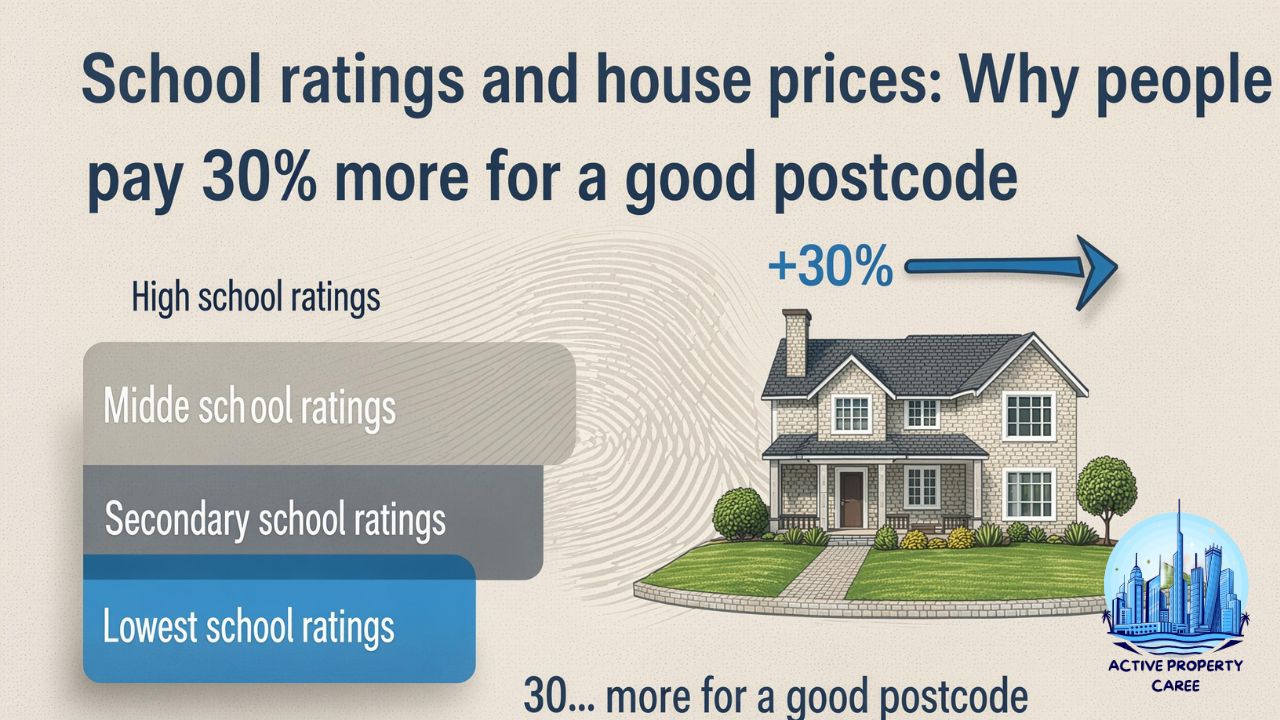
Data indicates homes around the best-rated schools can receive 30% premiums, especially in down markets. For investors looking to capitalize on these high-demand areas, programs like investment property mortgage programs can make it feasible to purchase and manage properties in sought-after districts. To understand why families prioritize these ratings helps explain the fierce competition and high entry costs in today’s most desirable American neighborhoods.
Education Impacts Valuation
The link between school performance and real estate value is one of the cornerstones of the American housing market. In much of the suburban corridor, a home’s “school score” is more of a price driver than its kitchen’s vintage or the size of the backyard. For buyers, a top-rated district is no longer an add-on but rather an essential amenity, on par with a safe street or proximity to major employment centers.
This coalescing request drives prices higher and higher in a perpetuating system. If a school goes from middling to elite ranking, the surrounding property values are generally on that trajectory within eighteen months.
Local Tax Synergy
Public education in the U.S. is funded primarily by local property taxes, establishing a self-reinforcing loop of high valuations. As the value of single-family homes increases, so does the tax revenue received by the local school board; this, in turn, implements new facilities, improved salaries, and more programs for teachers. This cycle produces an array of benefits that further enhance the neighborhood’s allure:
- Improved school facilities, such as modern classrooms, labs, and athletic complexes
- Enhanced reputation that draws affluent families willing to pay premium prices
- Strong property value resilience even during broader market downturns
These upgrades also add to the school’s reputation, drawing wealthier buyers who are delighted to pay a premium to gain entry into the ecosystem. This cycle renders certain zip codes nearly immune to the price stagnation noted in areas with less robust or uneven school funding.
GreatSchools Rating Premium
We know that an overwhelming number of modern buyers use digital aggregators like GreatSchools to filter their home search even before they send the first email to a realtor. These platforms emit a simple numerical score, from one to ten, that has become an argot for neighborhood quality.
Studies have shown that for each one-point rise in a school’s score, home values within that particular zone can increase by thousands of dollars. This digital glass is such that a low score can actually turn off a huge portion of the buyer pool, regardless of the home’s actual state or architectural credentials.
Quantifying The Gap
A statistical look at major metropolitan areas confirms that houses in “10-rated” districts frequently sell for twice as much as homes in “4-rated” districts, even when the houses sit only a few miles apart. This gap is not simply a matter of preference; it is an intentional financial decision made by parents.
The families rationalize the bigger mortgage payment with a comparison to paying for private school tuition for multiple children over twelve years. The postcode comes at a so-called “premium,” which is essentially an education fee that is paid for in advance and remains connected to the physical asset by way of the property. So to best navigate this high-demand market, families can:
- Do your homework on school ratings: Check state and independent school reports, student outcomes, and local reviews for the highest-rated districts.
- Examine price differentials: Compare homes of similar size and features in different districts to see how much you pay for top-ranked schools.
- Do long-term math: Consider the cost savings of not paying for private school versus the inflated mortgage and all interest and property taxes associated.
- Look for financing options: Explore programs that may provide investment property mortgage programs or specialized loans to assist with the higher upfront costs.
- Plan for resale value: Consider how the ideal location may affect long-term appreciation and real estate marketability.
Adhering to these steps enables families to make strategic choices that harmonize education interests with financial strategy.
District Boundary Shifts
The precise location of a school district line is maybe the most closely examined border in local government. One street can mean a $100,000 price difference if one side feeds children into a coveted high school and the other does not.
These lines aren’t always permanent, and “redistricting” threatens to be an immediate source of anxiety for homeowners. For example, when a school board is considering adjusting the boundaries for students in order to balance out enrollment, property values can change overnight in both areas, given that “brand” breaks down as the address has increased or decreased value based on how people view its proximity to the market.
Market Entry Barriers
These neighborhoods are often gated by economics, not physical walls, as prices soar in the face of school demand. High entry costs make sure that only large-capital or high-income buyers can move into the area, which further solidifies the neighborhood’s socioeconomic profile.
For middle-class families, that often means settling for smaller, less spacious homes just to get “a foot in the door” of a specific district. They might prefer a small, rundown place in a top zip code to an updated mansion in one with lower ratings, since the long-term benefit of location beats the short-term discomfort of limited living space.